
Lahore: Organized by the Youth Mental Health Committee, K Chapter – Pakistan Health Parliament
How do global legal frameworks uphold mental health rights? What best practices can be integrated into Pakistan’s own legal system?
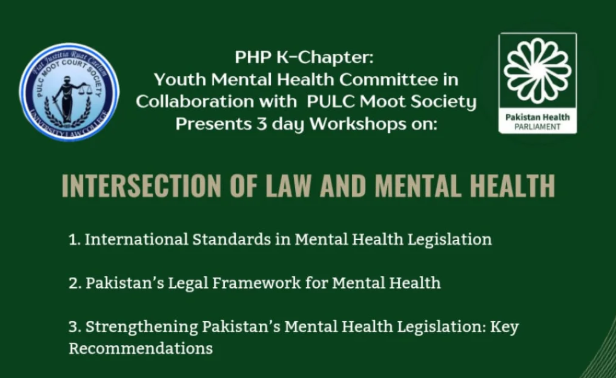
In the first module of this insightful series, we hosted Jhanzaib Ahmad Khan — Legal Expert, President of PULC Moot Court Society, and Instructor at Jurist Path. As an academic writer and seasoned legal educator, he delivered a compelling session on international mental health legislation, addressing:
🔹 Key global frameworks and conventions
🔹 Legal challenges in mental health rights enforcement
🔹 Pathways for legal adaptation in diverse jurisdictions
In the second episode of our digital workshop, Jahanzaib Ahmad Khan – Legal Expert, President of PULC Moot Court Society, and Instructor at Jurist Path – continued his thought-provoking discussion on global mental health laws and frameworks.
This session focused on:
🔹 The Convention on the Rights of Persons with Disabilities (CRPD) – Understanding how international treaties advocate for the dignity, autonomy, and rights of individuals with mental health conditions.
🔹 WHO Guidelines for Mental Health – Exploring global health standards and policy recommendations for ensuring ethical and effective mental health care.
🔹 Key Principles of Mental Health Legislations – Including informed consent, community-based care, protection against discrimination, and access to treatment.
This episode deepened participants’ understanding of how international legal instruments can be used as blueprints for strengthening Pakistan’s own mental health legislative landscape.
In the third and final episode of this module, Jahanzaib Ahmad Khan — Legal Expert, President of PULC Moot Court Society, and Instructor at Jurist Path — explored the real-world application of international mental health standards in Pakistan and the path forward.
Key discussion points included:
🔹 Challenges in International Compliance in Pakistan – Legal, institutional, and policy-related barriers that hinder the effective implementation of global mental health frameworks.
🔹 Recommendations for Strengthening International Standards – Practical and context-sensitive strategies to bridge policy gaps and align national legislation with global commitments.
The session concluded with a dynamic interactive segment, where participants engaged directly with the speaker, shared insights, and asked compelling questions.
Khadija Zafar, Vice President – PULC Law Moot Society, was featured in this workshop in to give her perspective on mental health legislation.
Her session provided a detailed understanding into the legal landscape of mental health in Pakistan, covering:
🔹 Overview & Evolution of Mental Health Laws in Pakistan
🔹 Constitutional Provisions on Mental Health
🔹 Legal Framework under the Pakistan Penal Code & Criminal Procedure Code
🔹 Mental Health Ordinance (2001)
Her insightful breakdown bridged the gap between theory and practice, setting a solid foundation for legal reforms that prioritize dignity, access, and protection.
In her second module, Khadija Zafar, offered a critical analysis of Pakistan’s fragmented mental health legal landscape, focusing on:
🔹 Different Provincial Mental Health Laws – A comparative overview of provincial mental health legislations, assessing their effectiveness and implementation gaps.
🔹 Key Issues in Pakistan’s Mental Health Laws – including overreliance on institutionalization, poor enforcement mechanisms, stigma & discrimination, and gaps in forensic health laws.
Her thought-provoking presentation highlighted the urgent need for harmonized and rights-based reforms to ensure mental health is treated as a fundamental component of human dignity and justice